
Albemarle County Court Records
After an Albemarle County arrest, the person may be booked into Albemarle-Charlottesville Regional Jail, but the charging record moves through the Virginia court system. ACRJ is a regional jail authority facility serving Albemarle County, Charlottesville, and Nelson County. That matters because the jail can answer some custody questions, while the court record depends on the locality and court where the case was filed. Virginia uses Commonwealth's Attorneys, not District Attorneys. For Albemarle cases, the Albemarle County Commonwealth's Attorney reviews the police or arrest charge and decides what charge to pursue, amend, reduce, dismiss, or present to a grand jury.
The booking side is narrower. ACRJ Records can help with custody, jail-credit, and release-calculation questions within its limits, but it states that warrants, dispositions, sentencing orders, and criminal-history records are not provided by the Records Department. For custody and booking context, use Albemarle County jail inmate records. For booking photos, use the Albemarle County jail mugshots and booking photos page. The court record after an arrest is the better source for the charge list, case number, hearing dates, bond events, and disposition.
Local boundary: ACRJ is the jail operator, while Albemarle County Sheriff's Office, led by Sheriff Chan Bryant, is a separate constitutional office with court security, civil process, and prisoner-transport duties.
Find Albemarle County Court Records
Virginia court records after an arrest are searched through official court systems, not through a jail mugshot gallery. The main statewide case information hub is the Virginia Court System case information page. General District Court matters can be searched through the General District Court Online Case Information System, and broader statewide case access may route through OCIS 2.0. For a recent Albemarle County jail arrest, start with Albemarle General District Court unless the facts point to Charlottesville, Nelson, Circuit Court, or a restricted juvenile or domestic docket.
The official screenshot source for the Virginia courts case-status portal shows that court access is split across case information tools rather than a single jail-run charge page.
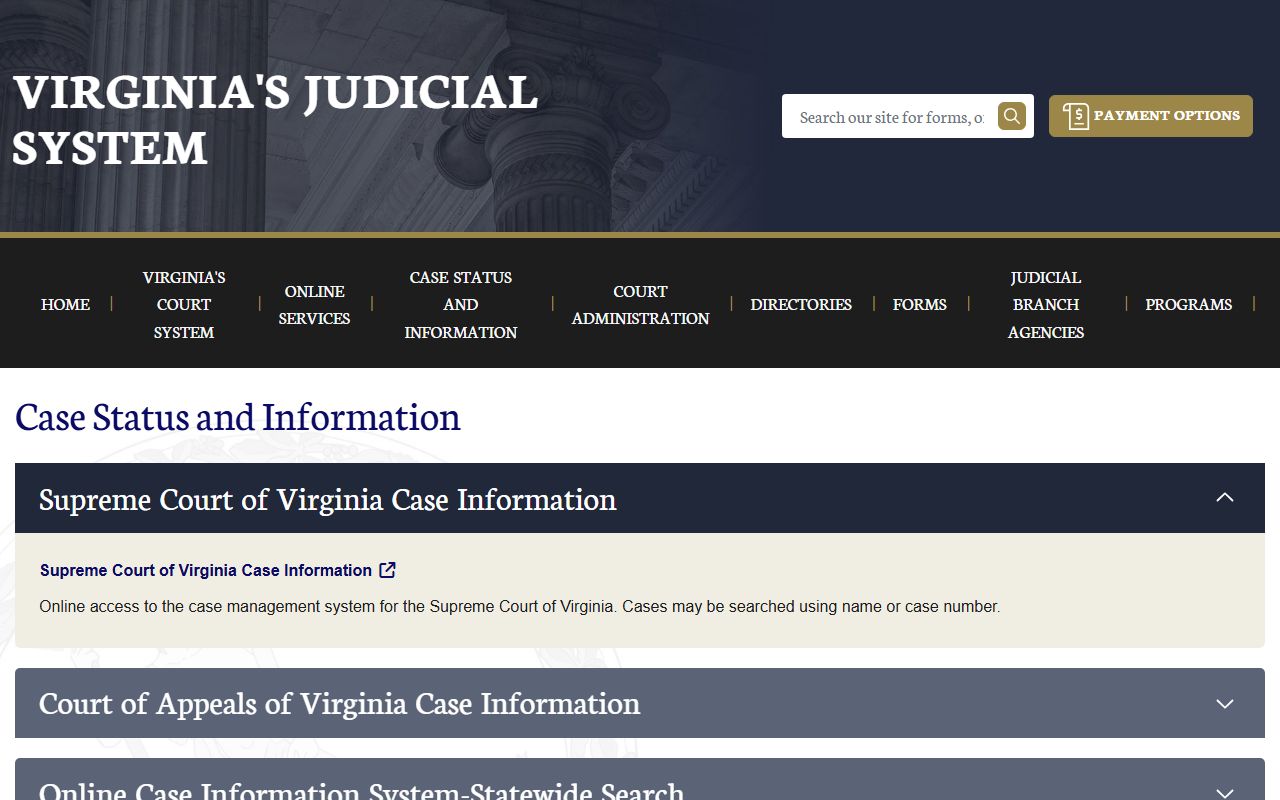
That split is useful because it keeps case status separate from jail status. A person may still be held at ACRJ while court orders are moving between courts and the jail, or the person may be released while the case continues in court.
- Open the Virginia court case information system that fits the court level and locality.
- Search by defendant name, case number, or hearing date. Use full legal names and spelling variants when the first search is thin.
- Open the case entry and compare court, locality, charge, case number, status, and next hearing date.
- Check whether the case is Albemarle, Charlottesville, Nelson, Circuit Court, or another court before relying on the result.
- Use ACRJ Records or Virginia VINE only for custody status, release processing, and jail-record questions.
| Field Label | Type | Required | Notes |
|---|---|---|---|
| Court or locality | Dropdown | Yes | Select Albemarle General District Court or the relevant Charlottesville, Nelson, or circuit court. |
| Search by name | Text | One route | Use the defendant's legal name and try spelling variants for common names. |
| Case number | Text | One route | Best when the number is known from a court notice, attorney, or prior search. |
| Hearing date | Date | One route | Helpful when a name search returns too many matches. |
| Case type | Filter | Varies | Use criminal or traffic settings when the portal offers a case-type choice. |
Arrest Charges Become Court Records
A jail arrest does not freeze the charge in place. The arresting agency may book the person on one label, a magistrate may set release conditions, and the prosecutor may later change how the charge is filed. In Albemarle County, the Commonwealth's Attorney is the local prosecutor for county cases. The office is listed at 410 East High Street, Charlottesville, VA 22902, with office phone 434-972-4072. Because ACRJ also serves Charlottesville, a city case may route to the Charlottesville Commonwealth's Attorney instead.
Charging documents explain why court records after an arrest can look different from the jail entry. A complaint or warrant can begin a misdemeanor or early felony matter. An information is a prosecutor-filed charge document. An indictment comes from a grand jury and is common for more serious felony prosecution in Circuit Court. When a felony is certified or indicted, the public record may show activity in more than one court.
| Document | Who Files It | Common Use | What to Check |
|---|---|---|---|
| Complaint or warrant | Officer, magistrate, or prosecutor process | Initial charge, misdemeanor case, or early felony matter | Charge wording, court, bond status, next hearing |
| Information | Commonwealth's Attorney | Prosecutor-filed charge in court | Whether it amends, replaces, or continues the arrest charge |
| Indictment | Grand jury | Serious felony or felony moved to Circuit Court | New case number, indicted charge, arraignment date |
Albemarle County Arrest Charge Status
Charge status is the key field in court records after a jail arrest. A pending charge is still open. A dismissed charge has been ended by the court. A nolle prosequi entry means the prosecutor chose not to pursue the charge at that time. A charge can also be amended or reduced, which means the public should not treat the booking label as the final court outcome. General District Court records can also show whether a felony was certified to a grand jury, which points the search toward Circuit Court.
| Status | Plain Meaning |
|---|---|
| Pending | The case or charge remains open and has not reached final disposition. |
| Amended or reduced | The prosecutor or court changed the charge from the original arrest or filing label. |
| Dismissed | The charge ended without a conviction on that charge. |
| Nolle prosequi | The Commonwealth's Attorney declined to pursue the charge at that point. |
| Certified to grand jury | A felony matter moved toward Circuit Court review and possible indictment. |
| Guilty or convicted | A final adjudication occurred by plea or finding, subject to any later appeal or order. |
ACRJ cannot process release until it receives actual court orders directly from all courts. That delay can matter after a hearing, especially when a person has several cases, detainers, or holds from more than one court. A court record may show a bond or dismissal before the jail has the paperwork needed to act.
Albemarle County Arrest Bonds
Bond in Virginia can be set by a magistrate or court. The release path may involve recognizance, unsecured bond, secured or cash bond, surety bond, or a no-bond hold. ACRJ does not publish a complete local bond-payment procedure in the source set, so the exact posting method should be confirmed with the court, magistrate, or ACRJ before any payment is made. The ACRJ communication page notes that bondsmen may ask the Chief of Security to be added to a list made available to inmates, but that should not be read as jail endorsement of a paid service.
| Bond Type | How It Works |
|---|---|
| Recognizance or PR | Release based on a promise to appear and obey court conditions. |
| Unsecured bond | No upfront payment, but the defendant may owe the bond if court terms are violated. |
| Secured or cash bond | Money or approved security must be posted before release. |
| Surety bond | A bondsman or surety posts the bond under a separate private arrangement. |
| No-bond hold | The person cannot be released on that charge or hold until a court changes the status. |
| Detainer | Another court, agency, probation office, federal agency, or ICE may block release. |
ACRJ Records says inmates must send an Inmate Request Form to the Records Department to learn bond amounts and court dates for charges they are currently held on. If an inmate is out on bond on a charge, ACRJ directs court-date and status questions to the attorney. That is another reason the court case search should be checked alongside any jail custody result.
Albemarle County Warrant Records
No official Albemarle County Sheriff's Office active-warrant search portal was located in the official source set. The sheriff's office remains relevant to civil process, court security, prisoner transport, and warrant-service context, but the public should not assume a countywide warrant lookup exists. If a warrant caused the arrest, the court case record may show a bench warrant, capias, failure-to-appear event, or other case action. ACRJ can confirm custody in some situations, but ACRJ Records states that it does not provide copies of warrants.
Warrant questions should be handled with care. An arrest warrant is a judicial command to arrest a person. A bench warrant or capias is often tied to failure to appear or violation of a court order. A search warrant is different because it authorizes a search, not necessarily an arrest. A fugitive, probation, parole, federal, or immigration hold may keep someone at ACRJ even if a local bond appears payable. For copies or case status, use the issuing court, counsel, or the relevant law-enforcement records process.
Note: A person who believes a warrant exists should contact counsel or the issuing court before choosing where and when to appear.
Albemarle County Charges Versus Convictions
A charge is an accusation or filed count. A conviction is a final court outcome after a guilty plea, verdict, or finding. Albemarle County court records after an arrest may show both, but they must not be read as the same thing. A jail booking charge is even earlier. It is the intake label tied to custody, not proof that the charge was proven in court. The prosecutor may change the charge, decline it, reduce it, or pursue a new indictment.
| Point | Charge | Conviction |
|---|---|---|
| Stage | Accusation or filed court count | Final plea, verdict, or finding |
| Proof level | Based on charging standards and probable cause | Requires proof beyond a reasonable doubt or a valid plea |
| Can change | May be amended, reduced, dismissed, or indicted differently | Can be affected by appeal, expungement, or later court order |
| Where to verify | Virginia court case search and clerk records | Final disposition in the court record |
Albemarle County Expunged Records
Some court records after an Albemarle County arrest may be restricted. Juvenile matters, some domestic matters, sealed filings, and records tied to an active investigation may not appear like ordinary adult criminal cases. Dismissal does not always mean a public record vanishes on its own. Virginia expungement is a separate court process under Virginia Code § 19.2-392.2, and it can involve eligible police and court records after certain outcomes.
| Point | Sealed | Expunged |
|---|---|---|
| Public view | Hidden or limited from ordinary public access | Removed from public access under an expungement order |
| How it happens | By statute, rule, or court order | By filing in the proper circuit court and obtaining an order |
| Typical trigger | Juvenile status, sensitive case type, or court restriction | Eligible dismissal, acquittal, or other qualifying disposition |
| What to verify | Ask the clerk or counsel about access limits | Confirm the scope of the signed expungement order |
Virginia FOIA also has limits. Virginia Code § 2.2-3706, effective July 1, 2026, supports release of nonjuvenile arrest and charge-status information and adult arrestee photographs, but it also recognizes limits tied to investigations and other protected records.
Background Check Boundaries
Casual court lookup is not the same as a certified criminal-history background check. ACRJ Records does not provide criminal-history information, and the research routes that subject to the Virginia State Police process rather than the jail. Court case systems can be useful for checking a known Albemarle County case, but records can be incomplete, restricted, delayed, or spread across Albemarle, Charlottesville, Nelson, Circuit Court, state custody, or federal systems.
Important: Do not use casual jail or court lookup results for credit, housing, employment, insurance, or any other FCRA-covered decision.